

It was a field trip for our Game Masters to present three games for a group of history students from the classes taught by our own Chris Ketcherside at Missouri S&T located in Rolla as part of our “History Through A Different Lens Initiative.” The games were designed to serve as an extra credit opportunity for the students complimenting their course work in their American History Classes. With a mix of gamers and non gamer students attending, our Highly Experienced Game Master/Facilitators (Mark Williams, Pat Lewis and Kevin Fitzpatrick) chose games that not only fit the historical periods requested but were easy to learn allowing the students to jump right into the problem solving process of the scenarios without the need of having participated previously in table top miniature gaming in the past.

First up was Mark Williams offering of Zeppelins Over London during World War I to give the students a look at the industrial era warfare of the 20th century. Using a modified version of Ares Games “Wings of Glory WWI” game system Mark lead the players through a night time terror bombing raid over the British Capitol.

The participants had to manage search lights, anti aircraft guns and their defensive aircraft as they made every effort to thwart the approaching behemoth.

The airship although slow and cumbersome was able to inflict some damage on the defenders air patrol causing a bit of pause by those targeted.
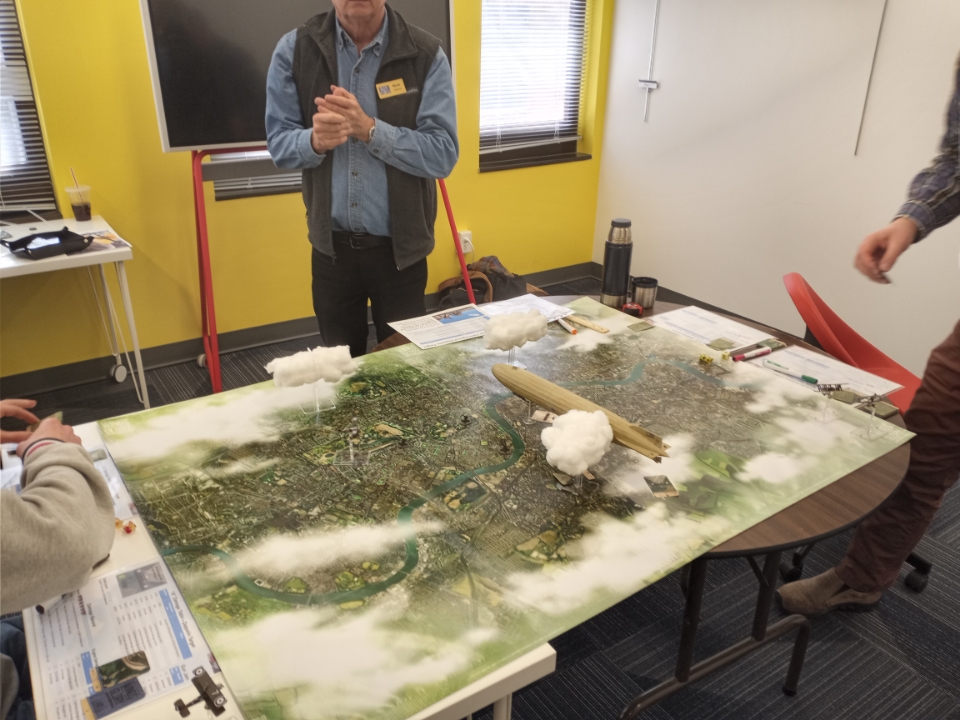
Mark reported that in the end London was saved by the heroic actions of the players as they defended it from not only the mighty airship but also a Gotha bomber which was also held off by the defenses.

Pat Lewis brought his superbly crafted enlarged 3D version of GMT’s “Plains Indian Wars“ taking the students on a trip across the continent as the United States pursued Manifest Destiny. There were railroads to build, wagon trains to push forward and areas to settle as the nation grew in the post Civil War era.

Pat went all out (as he always does) building what is easily a museum quality presentation combining his fantastic terrain building skills with resplendently painted miniatures that replace the game components of the original boxed board game.

The map comes alive for the players with mountains, cities, rivers, deserts, oceans and forests all displayed in such an appealing manner.


With a clear explanation of the objectives and the rules the students were engaged quickly in the exercise.

Pat reports that all of the players did well and left with a better understanding of the Westward expansion of the late 1800s.

Our third game offering was taken from the American War of independence as we looked at the Attack on Cahokia, IL by a British organized force of Native Americans on 26 May 1780.
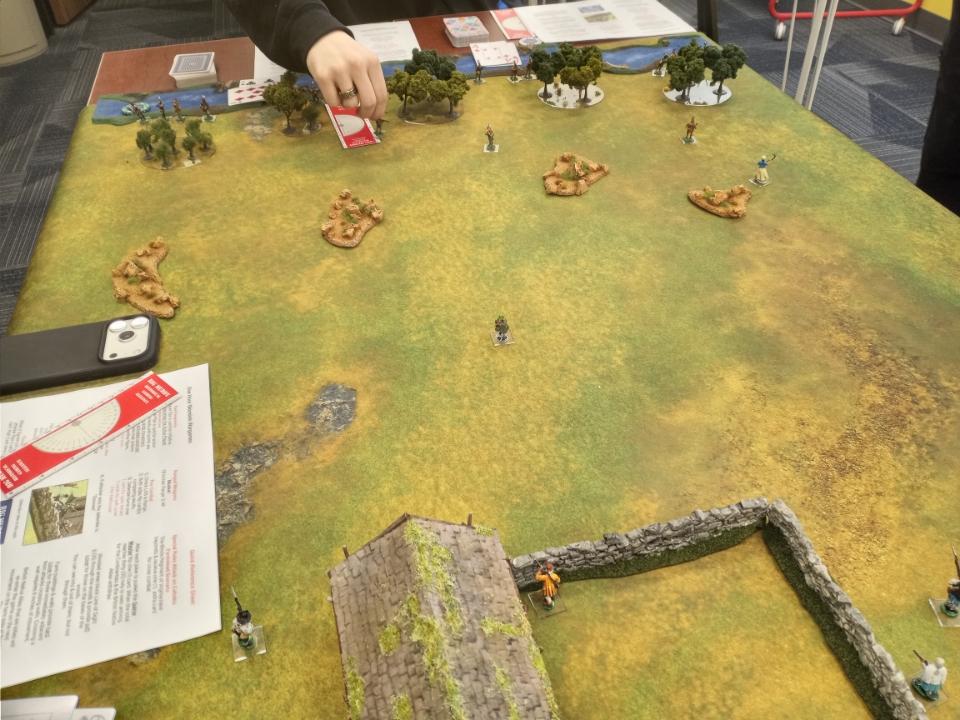
Using John Lambshead’s “One Hour Skirmish Wargame” Rules we presented Cahokia Farmstead. This scenario is based upon the cover artwork of Steve Kling’s “Attack on Cahokia” board game and is one that we have presented at the St. Charles County Heritage Museum and St. Charles Community College.

The premise of the scenario is the Native American attacking force coming from Rigolet stream and encountering the first of multiple farms as they approached the main position of Cahokia.

As the name of the rules clearly state this is a “one hour” game system and hence and easy to learn one which is entirely card driven for all aspects, player initiative, action points (for movement and combat) and combat itself.

The students picked up on the system quickly and got right down to figuring out the nuances of the scenario. Working the problem to try to create as many advantages for themselves as possible.
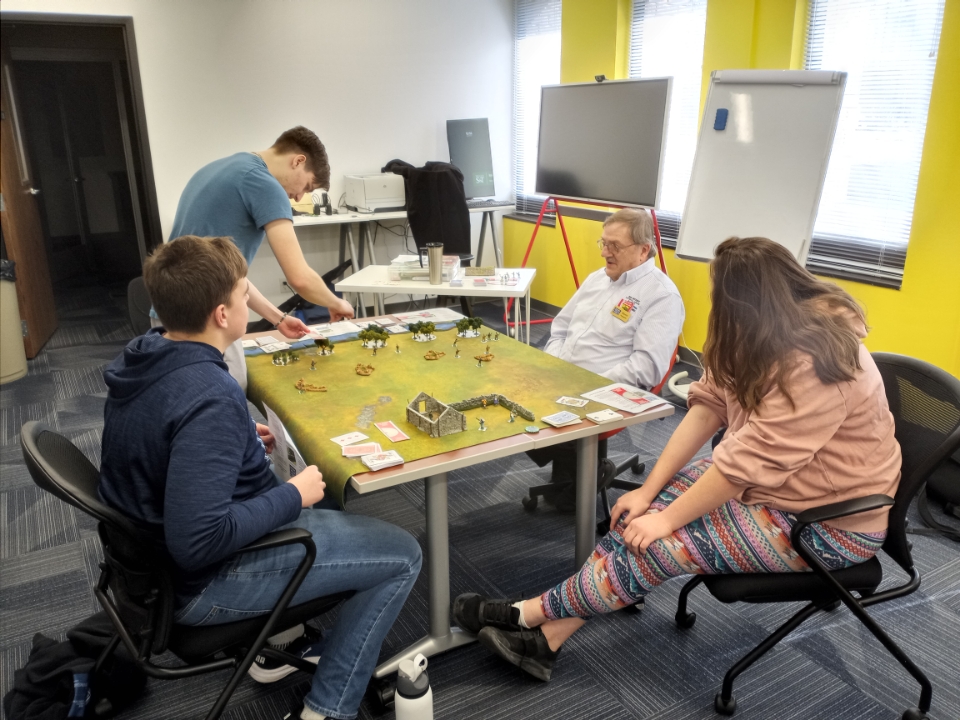
The students became so comfortable with the game system that they were essentially running the game within several turns. Keeping the game moving along, calculating probabilities and formatting strategies.

As has been said, “No plan survives first contact with the enemy” and this proved to be the case in this in our two games. The game system is designed to create uncertainty and chaos which represent the fog of war and it succeed on more than one occasion in our games. Safe to say, it was not a very good day for the settlers. However, in both games Native American losses reached 30% and would not have been sustainable.

Thanks Chris Ketcherside and to all the student players and faculty who joined us for out visit to Missouri S&T. It is our hope that everyone took away something positive from the experience as we used historical table top miniatures games to facilitate learning a bit of “History Through a Different Lens. “


Absolutely splendid event! Well done, Kevin.
Thanks Les! It was a wonderful day interacting with the students and I am in hopes that we will be able to return next semester.