
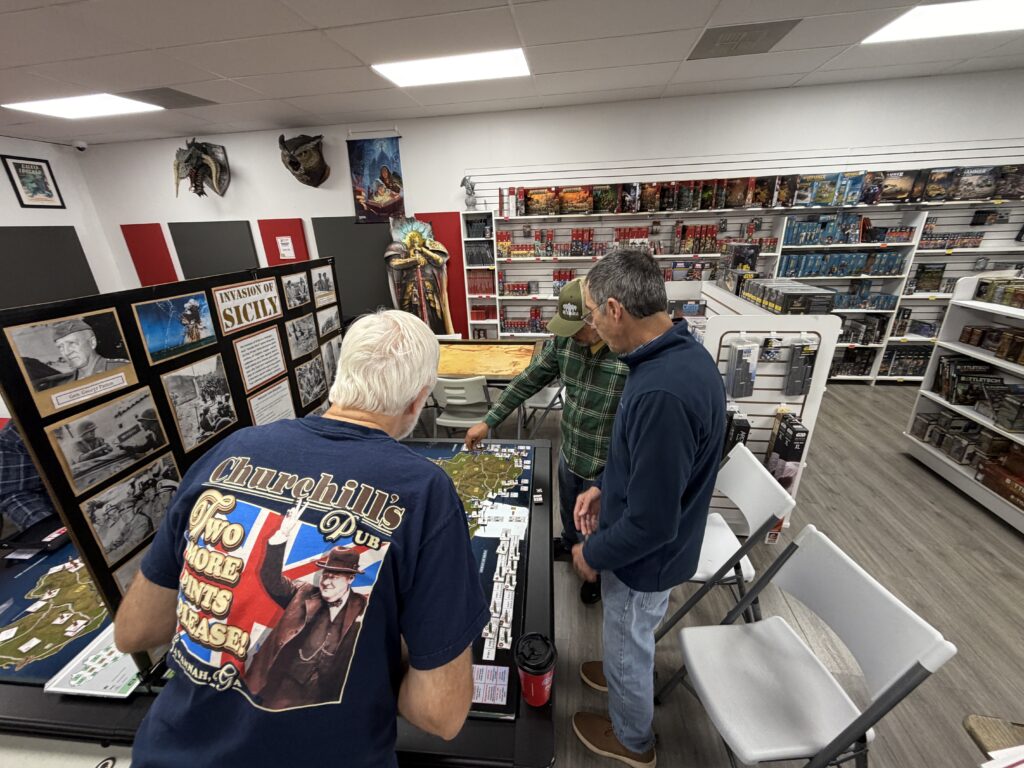
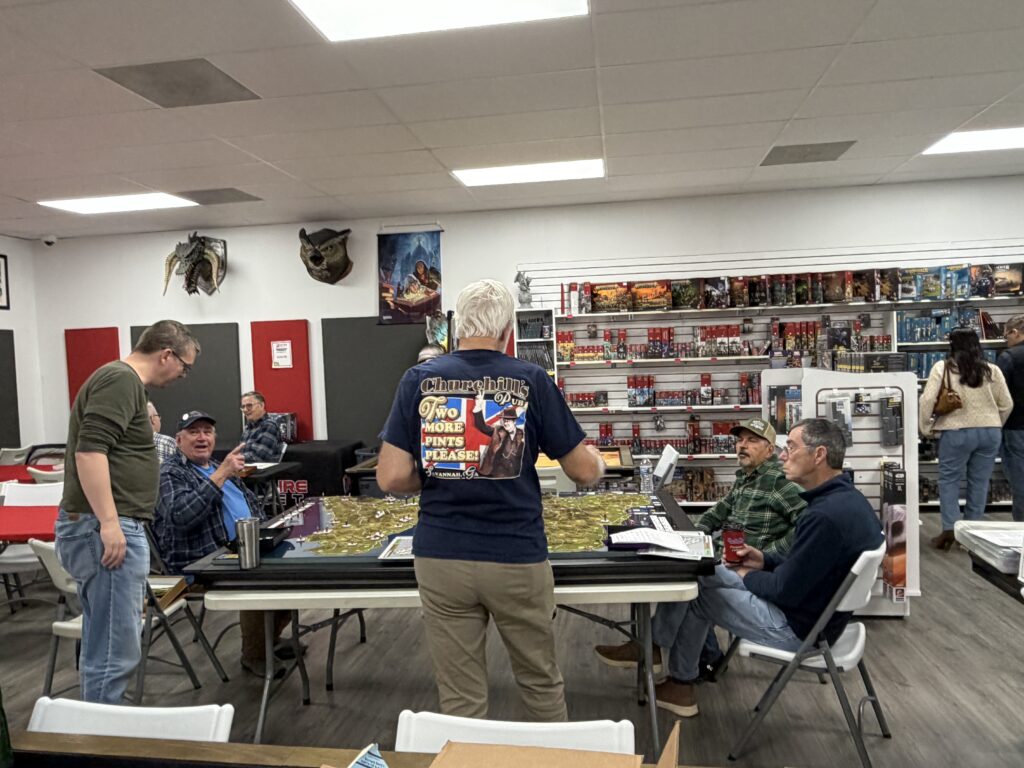
Our Autumn Feature Event Command Con Lite was combined with our November Game Day West. As is always the case our Game Day West was held at Miniature Market Rock Hill on Manchester Road. Our GMs provided us with some intriguing scenarios to challenge the players in a variety of historical situations seeing if they could best the records of the commanders.
One game that really attracted attention was Mark Lueckenhoff’s double blind Sicily. Mark was not only a very busy game master but also was
kind enough to send in a great report of the game for us all to enjoy so we will turn the tale over to him…..
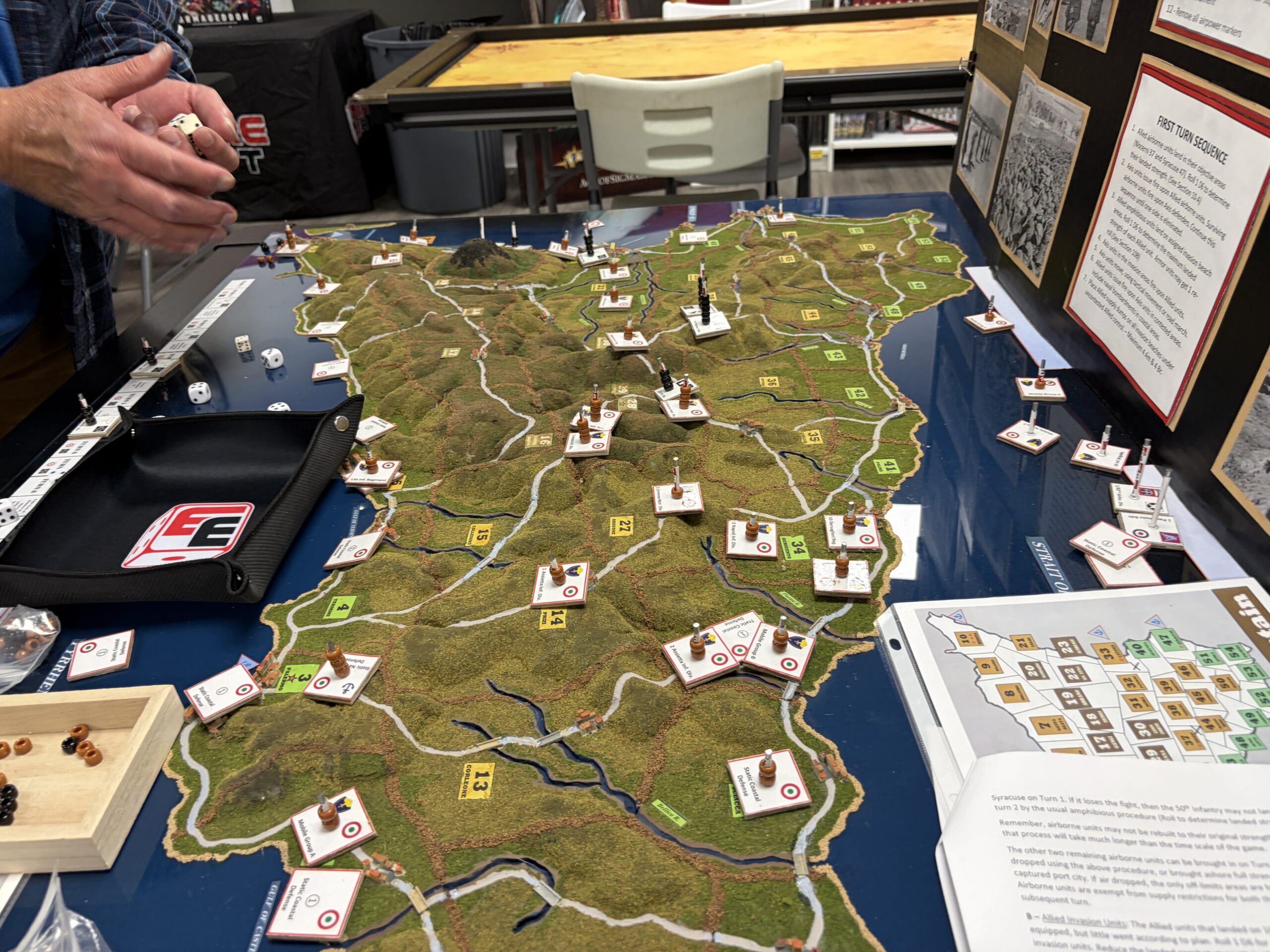
“The CommandCon Invasion of Sicily game turned out to be quite interesting. The players enjoyed it and the double blind aspect echoed many historical aspects of the real invasion. The 3-D boards that Pat Lewis built for this game are amazing – and he finally got to play on them!”
“The first turn is always a crap shoot for the Allies. They are landing many strong units – actually more men on the fist day than on D-Day in Normandy a year later. Over twice as much beach frontage… From much farther away… For the first time… While the Luftwaffe and the Kriegsmarine were still very potent forces. So much can, and usually does, go wrong.”
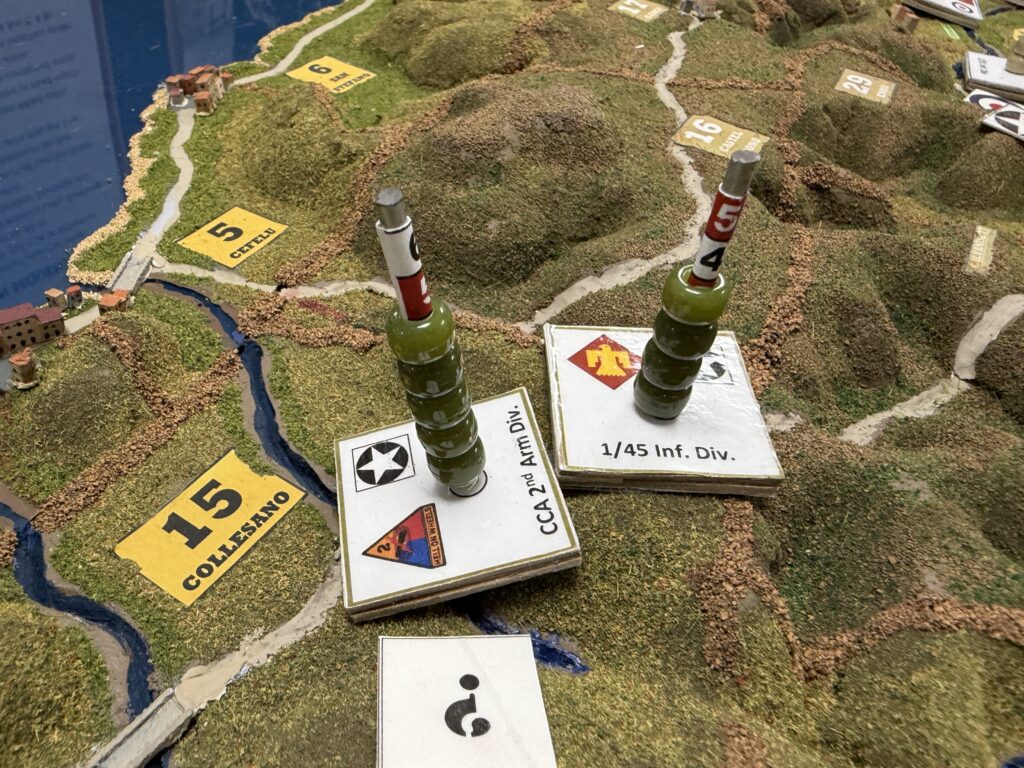
“Assigned to capture both Syracuse and the Niscemi airfield complex on the first turn, the airborne forces took a real beating and both the Americans and Brits failed to take their objectives. It took several more turns for the British amphibious landings to fight their way into Syracuse and secure it as a supply source. And the airborne battle for the Niscemi airfields turned out to be just a prelude to the real struggle as both sides rushed in reinforcements. American losses were higher, but they were better able to sustain them. It wasn’t until midway through the game (the equivalent to roughly twenty days of combat) that the Americans finally took possession after nearly cutting it off by outflanking.”
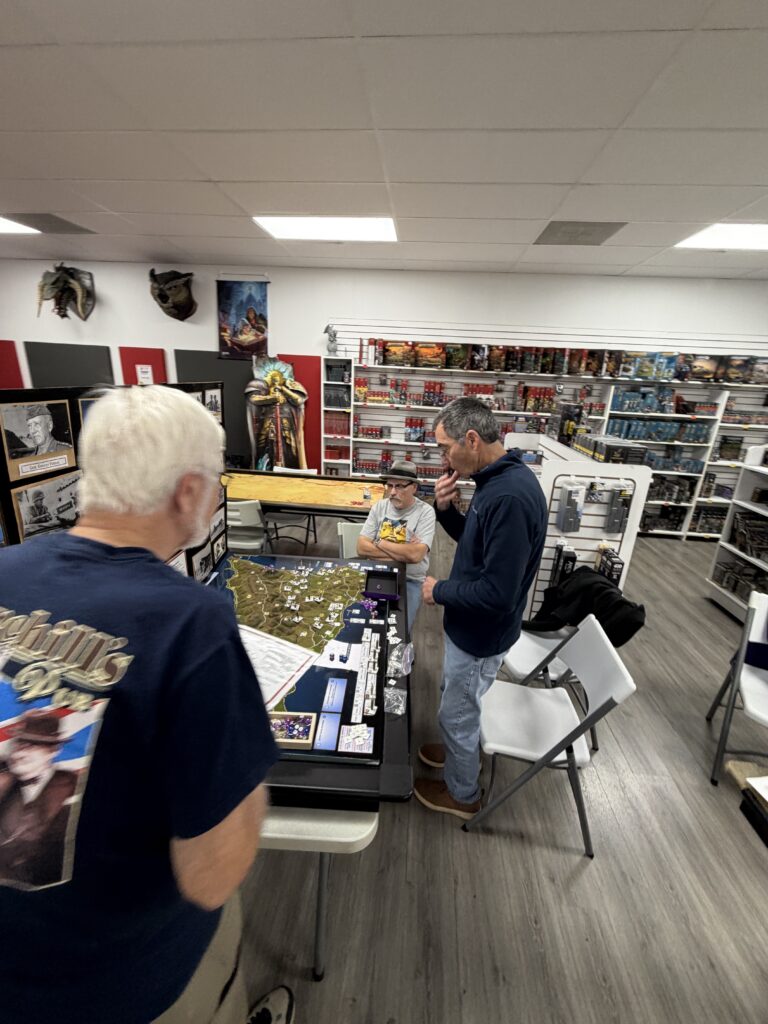
“Most of the Allied amphibious forces landed in reasonably good order, with only a couple of divisions taking heavy initial losses. Supply dumps were established and rebuilding began as the most intact units in the first wave moved forward. Just as in the real invasion, congestion on the British route along the east coast led to logistical problems, especially along the boundary with the Americans.”
“After the American first wave and reinforcing troops advanced north into the struggle for the airfields, the Italians got creative and advanced along the southern coast road from the west. Since most of the Italian units were very small and mostly immobile, this was not expected. They were rewarded with a clear path to a supply dump, which they eliminated. The small American amphibious force that was left attempted to land west of them on the coast road to cut off the Italians, but the static shore defenses made this difficult. These amphibious attacks and a reshuffling of forces in the rear area managed to keep the Italians for destroying any more supply dumps and eventually eliminated them.”
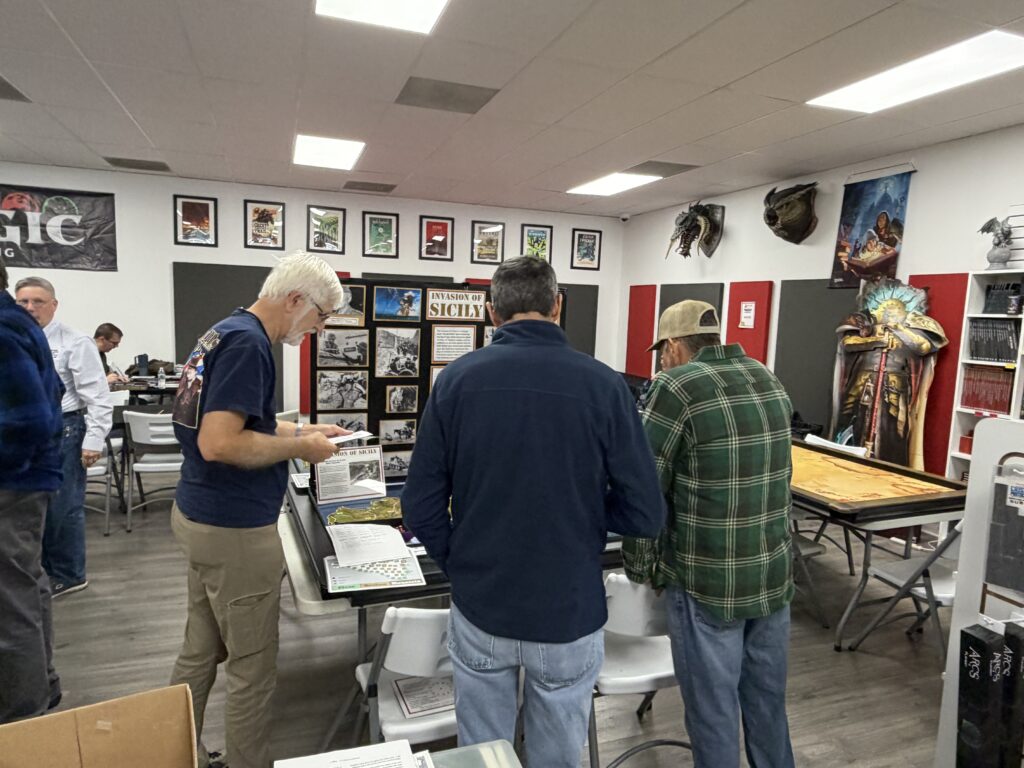
“The British fought a war of attrition as they slowly advanced up the east coast. Once they could systematically cycle forward fresh troops while sending battered ones back to rebuild, the balance began to turn in their favor. The Axis had no such luxury.”
“Shore bombardments added to the British numerical superiority as they worked their way up the east coast. The Axis made a major effort to reduce that capacity with a massive air assault on the Allies naval assets on the second turn, but cold dice rendered it ineffective.”
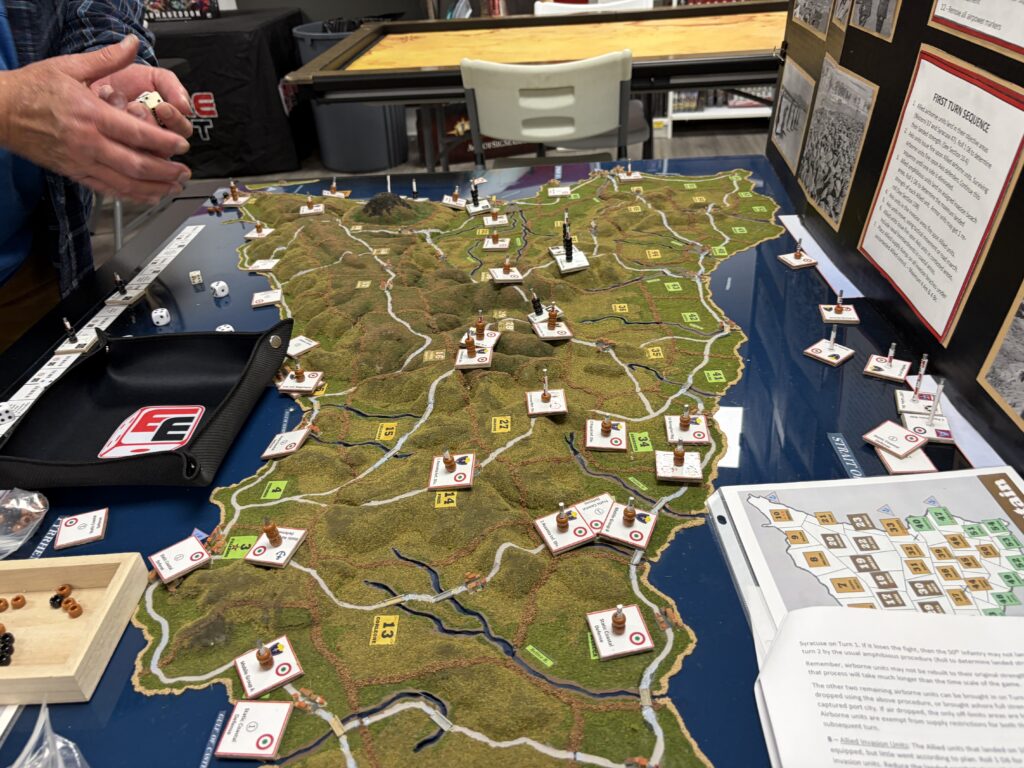
“The weather was good through the whole game, so air power played a major roll. After that second turn attack on naval assets failed, the Axis mostly used their airpower for intercepting Allied ground support missions. Combined with some incredibly lucky anti-aircraft rolls, it managed to deprive the Americans of air support in several crucial battles. Later in the game, the Allies began to experiment with using airpower to interdict supply lines, which proved to be rather effective.”
“Eventually the thinning Axis lines gave way before the Americans and they streamed toward the port of Polermo on the western coast, cutting off an essential supply source for the Italians. Then it was a race for the ultimate goal of Messina. This time Montgomery was able to arrive first, but only because the Americans ceded some of their operational space so that the British could outflank the Germans along the east coast without being cut off from their own supplies.”
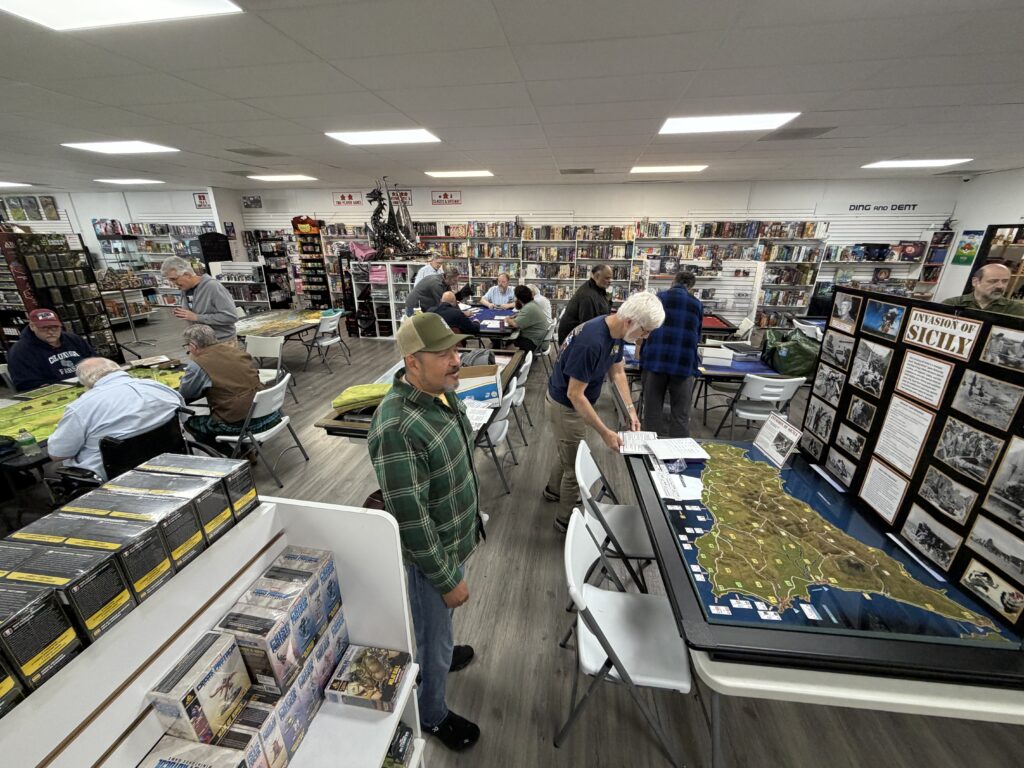
“In spite of eventually losing Messina, the game had to be considered an Axis victory. They managed to evacuate all of the surviving German and Italian mobile units – and nearly all of the German units did survive to fight again another day. The upcoming battle for Italy just got a lot harder.”
“The double blind aspect really added a lot to this scenario. The Americans, for example, would have seen the Italian threat to their supply dump coming and never left it unguarded. Unseen gaps and weak spots that could have been exploited were left untested. Tremendous amounts of firepower were sometimes directed at positions that were already virtually abandoned. Both sides had to make decisions about how to allocate their assets without knowing the either the strength of the plans of the enemy.”
Mark Lueckenhoff
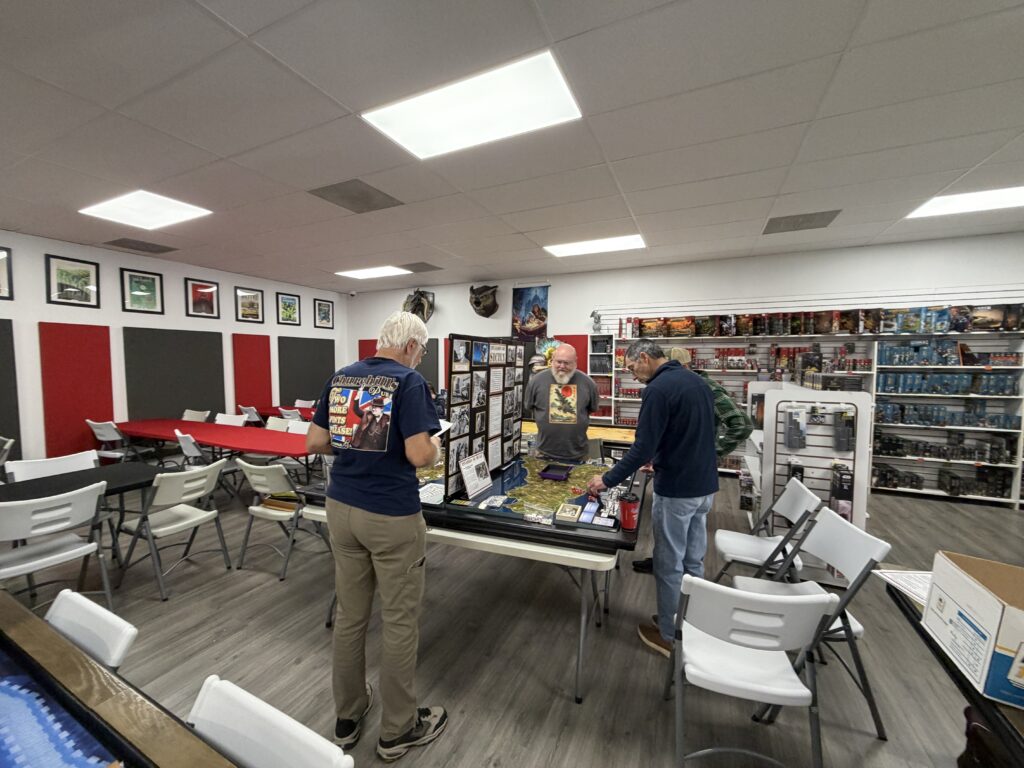
Thanks to Mark for running this interesting and challenging scenario and the write up. A Thank You Sam who came along with Mark from the Hannibal area and to all the players who came out to enjoy a fun afternoon of gaming. As always we extend our ongoing appreciation to Miniature Market Rock Hill for their continued support.
Remember to shop local!
Big Muddy Historical Game Alliance of Greater St. Louis
Our public educational demonstrations including rules and game evaluation sessions use historical miniature and historical board gaming to explore military history, historical decision-making, and the people, places, and events of the past.
Historical Gaming in Action is a public educational program presented by the Big Muddy Historical Game Alliance of Greater St. Louis.
Using miniature figures, terrain, maps, historical research, and guided play, our games explore military history through the decisions faced by commanders, soldiers, and communities. Visitors can examine the table, ask questions, learn about the historical setting, and—when space and time permit—join the game.
Our scenarios are based on historical sources. While game rules simplify some details for practical play, each event is designed to encourage discussion of historical events, geography, leadership, logistics, strategy, and the human experience of conflict.
Historical gaming can be both enjoyable and educational. Big Muddy provides public educational demonstrations, seminars, and convention programming that promote historical miniature gaming and military history.


