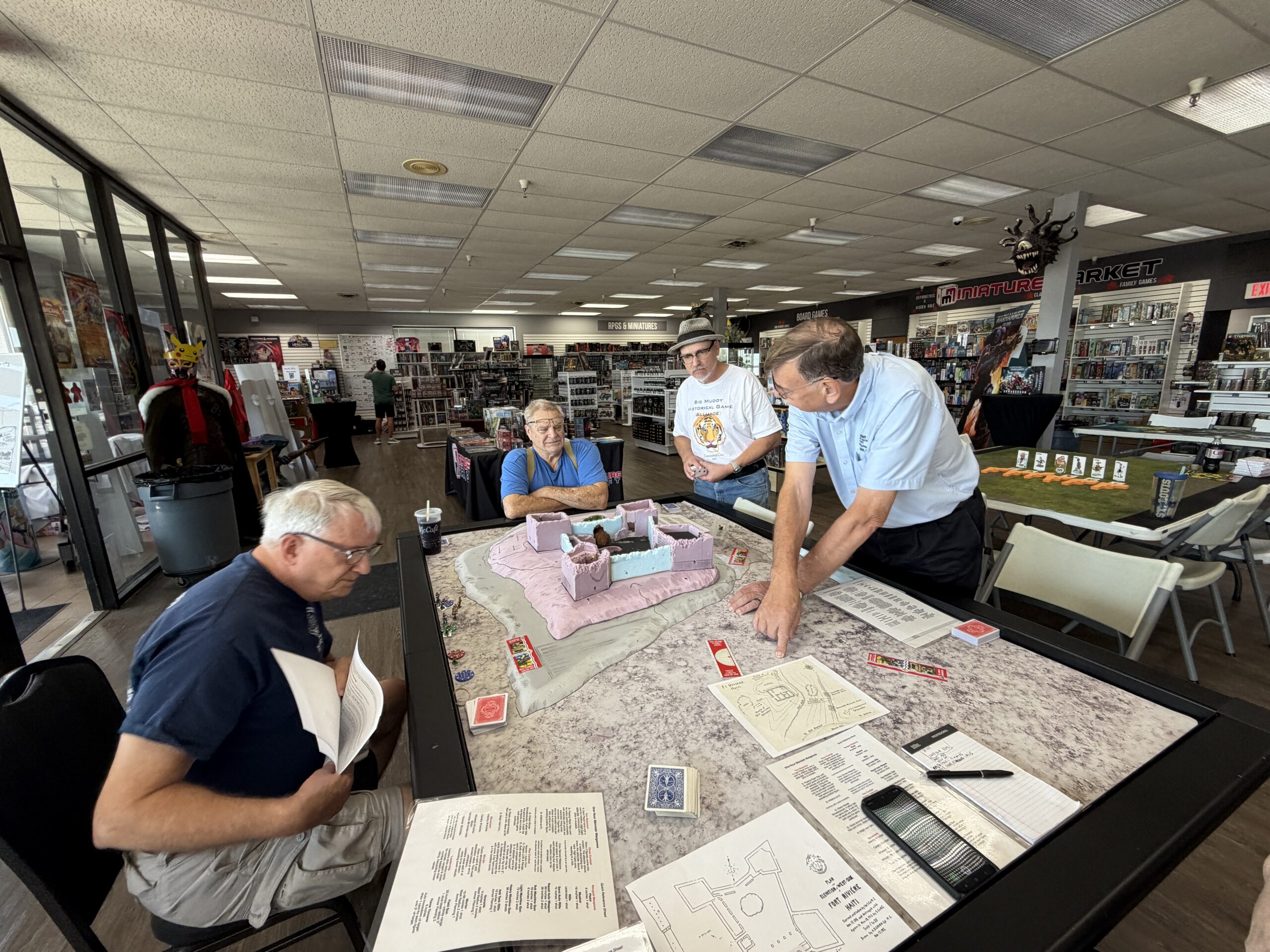
The Thursday group gathered at Miniature Market Cave Springs to run through the first draft of The Battle of Fort Riviere 1915 using One Hour Skirmish Wargame Rules by Jon Lambshead. This game is being prepared for our upcoming visit to St. Charles Community College this Autumn season.
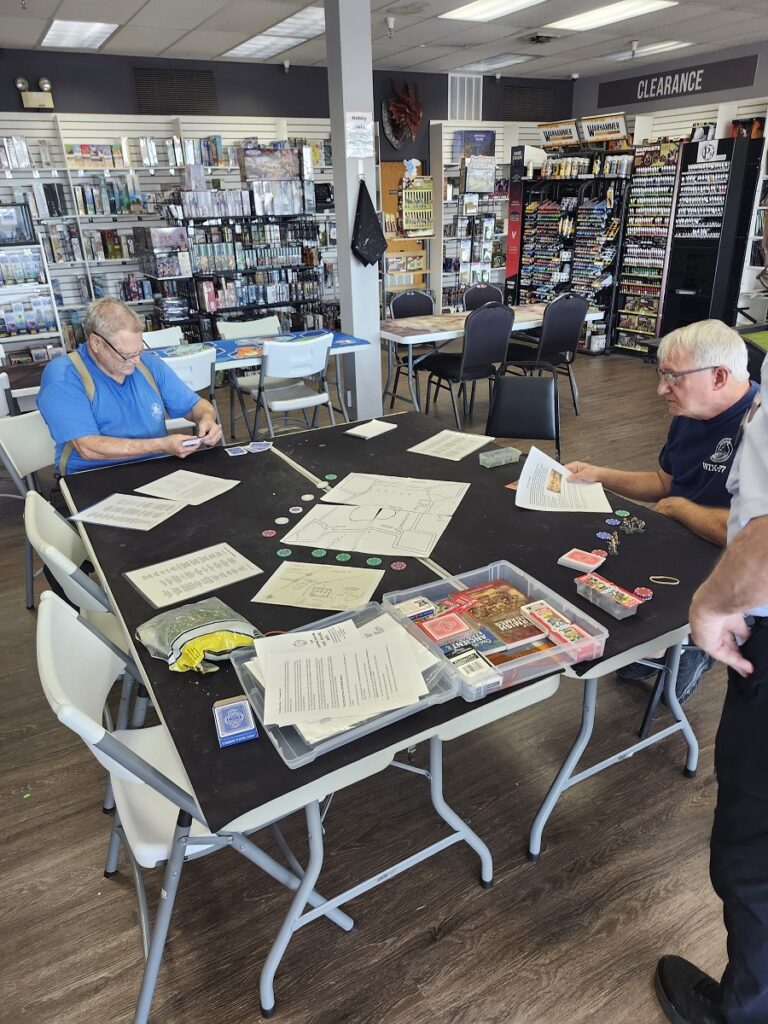
We started set up using a paper rendition of an image of Fort Riviere provided to us by the Museum of the United States Marine Corps.
As this was the first draft and this was more of a working session than a gaming session. The scenario needed to be tweaked, standard rules needed adjustments to reflect the historical realities and discussions on balancing the game system vs the historical situation needed to be heard and conclusions reached.
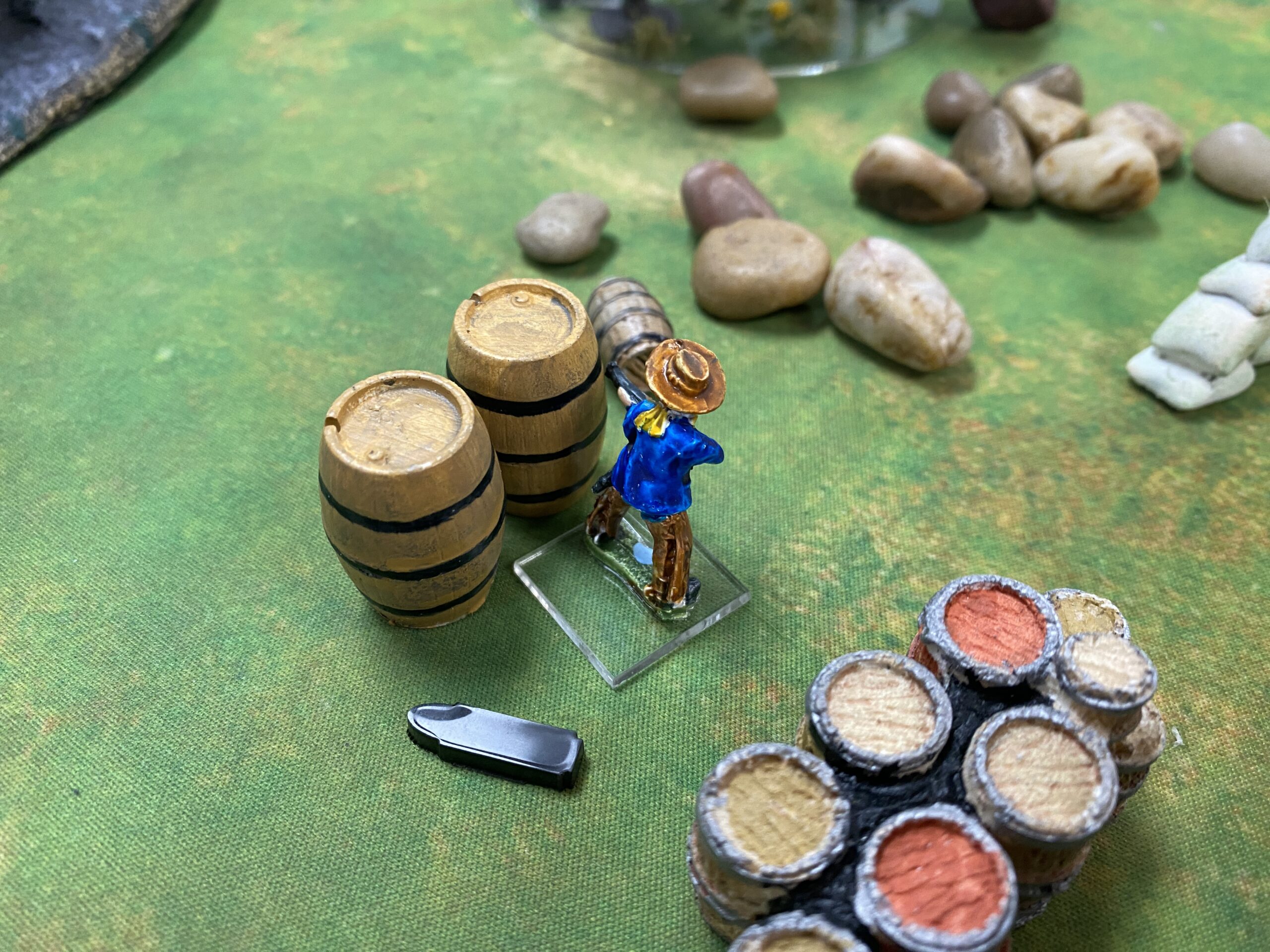
This very much work in progress included substitute miniatures with 25mm Ral Partha Boers filling in for the Haitian Native Cacos, (Steve T, DJ and Mark J) The USMC (Steve L and Pat L) were represented by Old Glory Spanish American Infantry. More accurate figs are on order from Brigade Games and are hoped to arrive shortly so as to be fully prepared for our event.
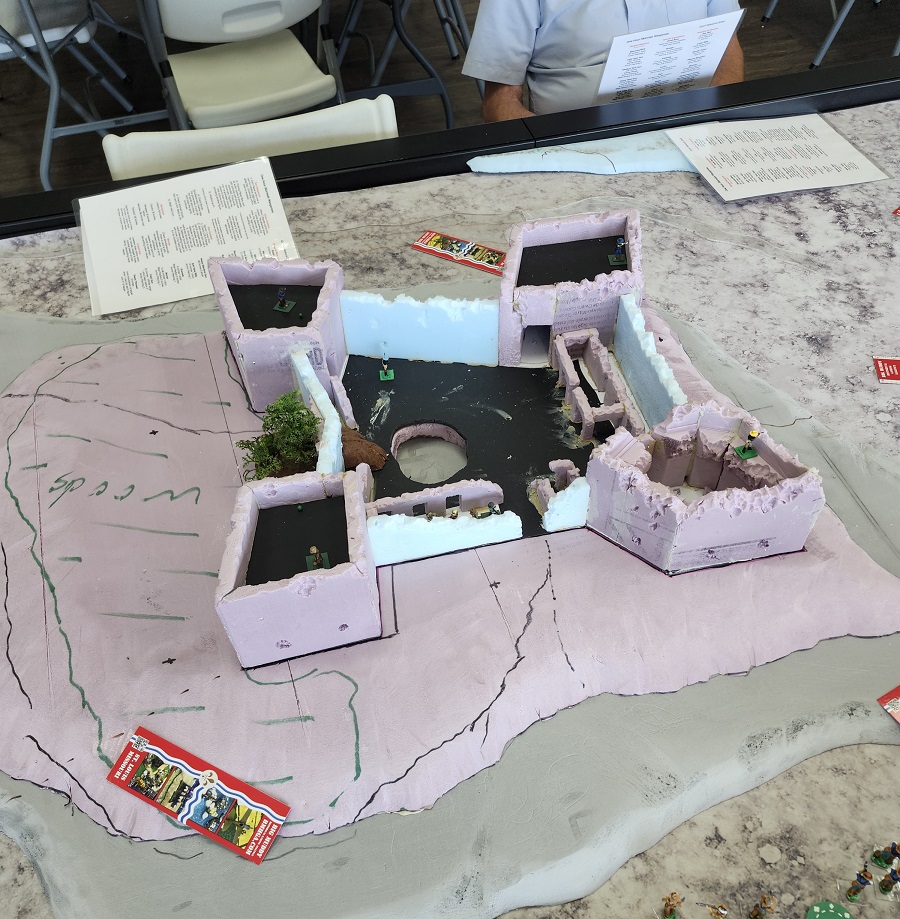
Fortunately Pat Lewis showed up after battling traffic bringing along his work in progress version of the Fort. Still lots to be done but it is shaping up nicely. I see this piece usable beyond this scenario and am already pondering some Caribbean pirates and perhaps a desert fort for Colonial Era games.
Our early 1800’s French fortress as you will note in the photos is still under construction by the talented hands of Pat Lewis one of our group’s best makers of gaming terrain.
Jay Clendenny was kind enough to focus on taking both notes and making valuable suggestions on rule modifications. These notes not only provide us with some description but help documenting the scenario rules that move the project forward to give the students the best experience that we can muster.
We will pass along Jay’s thoughts on the table top action…
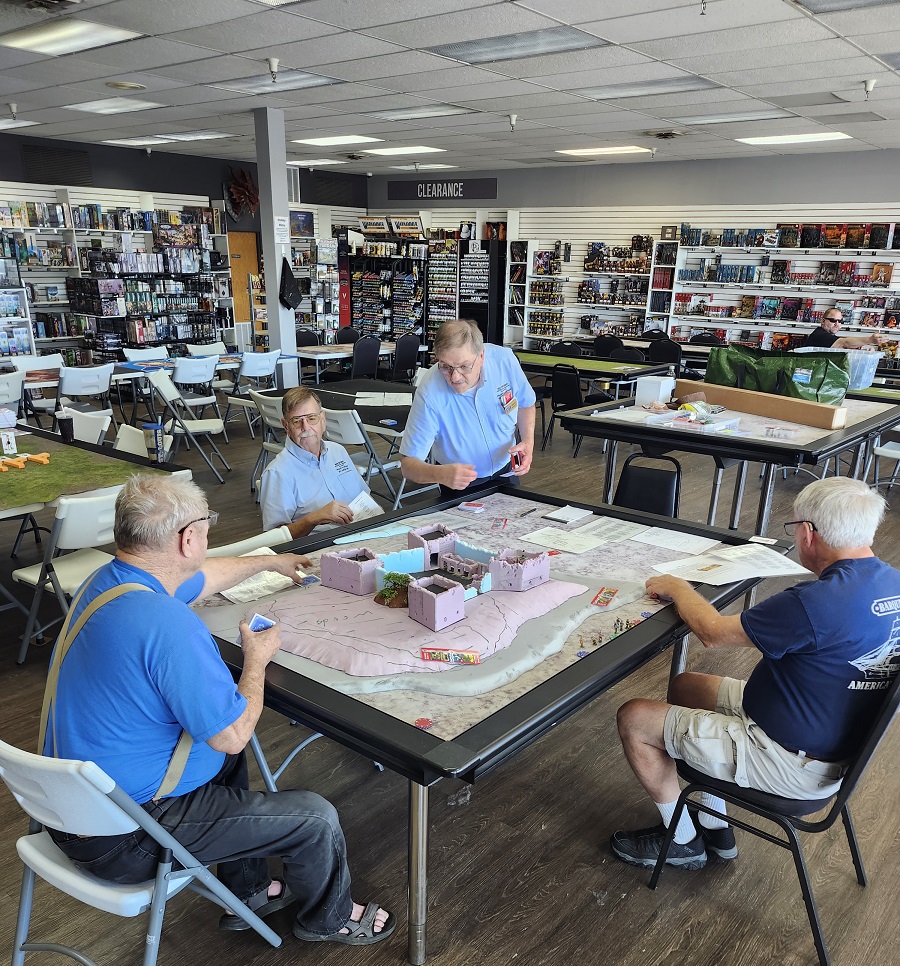
Giving you a size reference to the fort on a 4c6 table.
“Major Smedley Butler was tired after several weeks of chasing and fighting Cacos in the hills and mountains of Haiti. The good news was they had crushed the Cacos every time there was a battle. The bad news was his target, old Fort Riviere, was located up on top of a mountain at 4000 feet. Butler had convinced his commanding officer that he could take the position now instead of waiting for more troops and equipment and he intended to deliver on that promise.”
“The retired gang got together for something a bit different this week. Kevin is working on a scenario for the battle of Fort Riviere in Haiti that took place in 1915. The scenario is in its early stages of development with the fort still under construction from Pat Lewis and the rules and parameters of the scenario still being worked on. In essence, this was a working session for the group to help with development for this particular scenario. Steve L and Pat took the role of US Marines while Mark J, Steve and DJ took the part of the Cacos defenders. Jay and Bill were observers with Gregg stopping by later.”
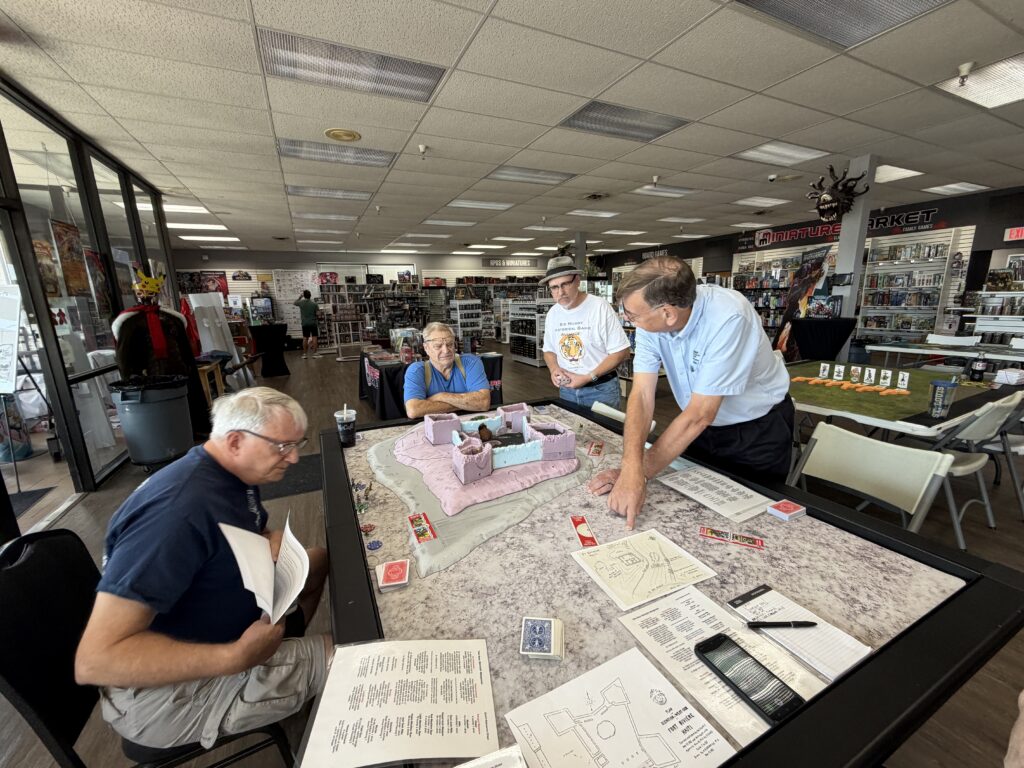
“In short, the US Marines and a contingent of USS Connecticut sailors were going to attack a old French fort that was in disrepair on top of a 4000 foot mountain that was filled with Cacos rebels/bandits. The objective for the Americans was to neutralize/capture the Cacos and break the back of the rebellion/banditry that had been plaguing Haiti. The fight itself isn’t necessarily difficult, but what makes it hard for this particular battle is the US had one person wounded (hit in the face with a rock) compared to 50+ Cacos dead. Trying to come up with a rules set that could duplicate a historical outcome like that while trying to keep it “fun” for players along with potential different outcomes is a big part of a good scenario and it is what makes this scenario a particular challenge.”
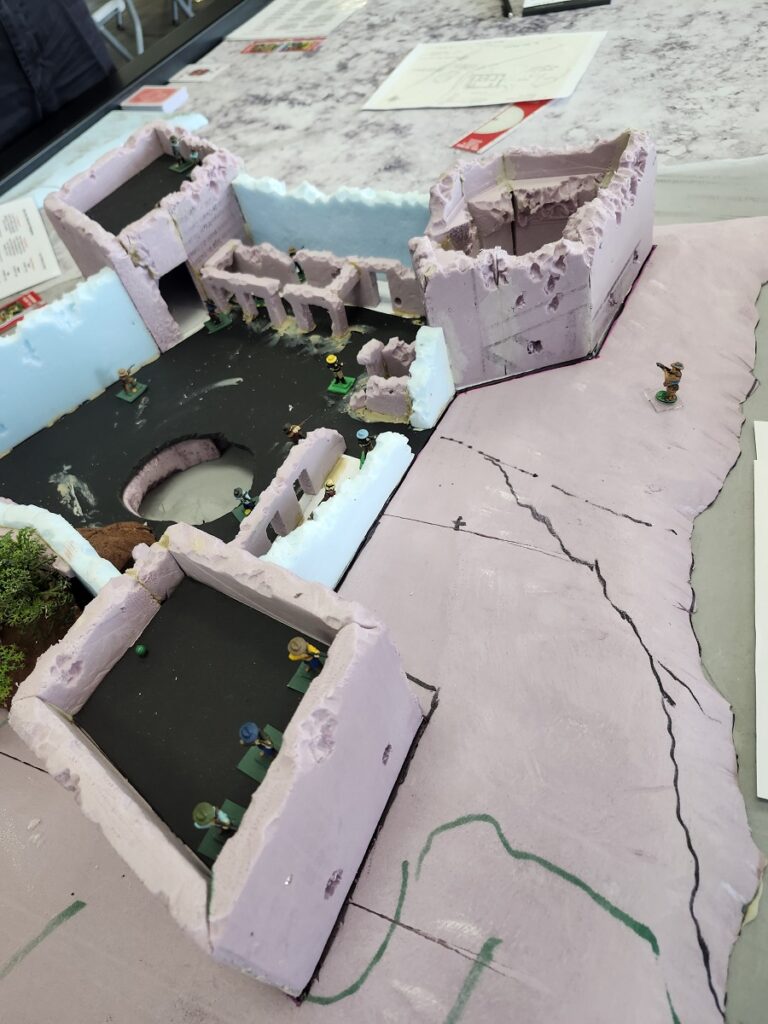
“With that, we got the terrain on the table along with a fort in the early stages of construction, and Kevin briefed the players. The base combat system in use is One Hour Skirmish Rules. This is a card driven system based on points that you get depending on what card you draw (Ace is always low and each card is worth face value with face cards being 11, 12, 13 for jacks, queens, and kings respectively). When fighting, players will draw cards to resolve the combat with the high card being the winner. Each unit (Cacos were divided up in to 3 units with the Marines being in 2 units) will draw cards for who goes when as well. “
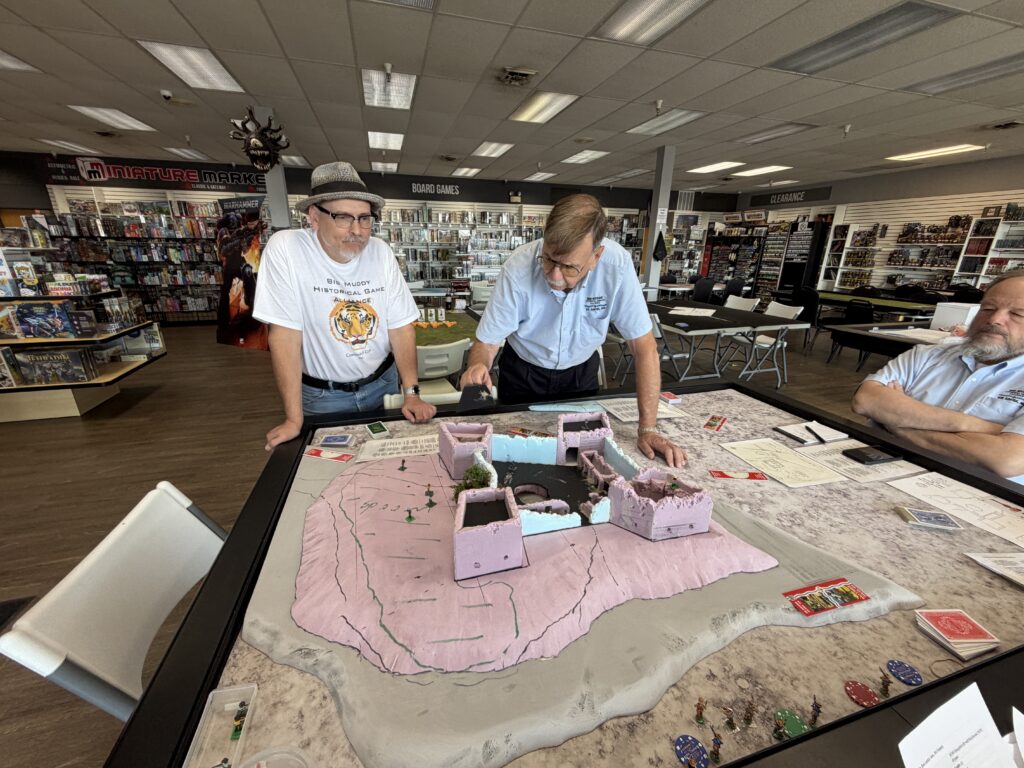
“The first run through had the Marines launching an attack against the west wall and another group with Major Butler in a tunnel under the fort moving up. It didn’t last very long as the Marines had trouble scoring any hits on the Cacos up on the fort towers (Only 1 attack card vs 4 defense cards due to cover) while the Cacos had a much better chance against the Marines (1 attack card vs 2 defense cards due to the woods). The Marine force attacking the west wall was relatively quickly put out of action and Major Butler’s group never really got out of the tunnel due to the distance they had to move and low card draws for action points. At this point, the group stopped and discussed options.”
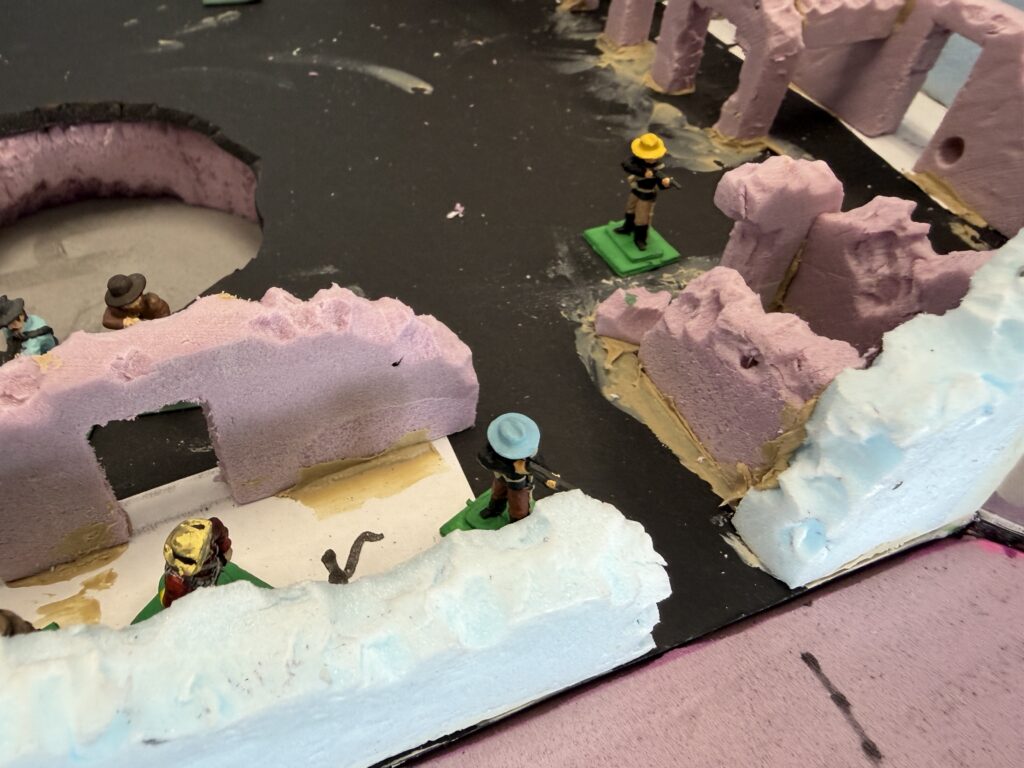
“The second run started with the Cacos allowed to have 1 person on “lookout” in 3 different towers. The others were “asleep” and not prepared for the attack. Butler’s group was moved up to the entrance inside the fort and would be able to enter the fort on the first turn. Marines were given some extra perks like drawing extra cards for their actions while the defending Cacos were given muskets (takes 2 actions instead of 1 to use). This run through felt much better as Butler’s group came in and were able to knock out 3 rebels right away on the first turn while the western group got to the entrance of the fort and were able to force their way in. Unfortunately even with the extra help in game mechanics, Butlers group was quickly put out of action (very bad luck drawing on defense for them combined with the Cacos being a little too good in melee combat) and eventually the western group was cut down as well. The group then had another brainstorming session on suggested changes.”
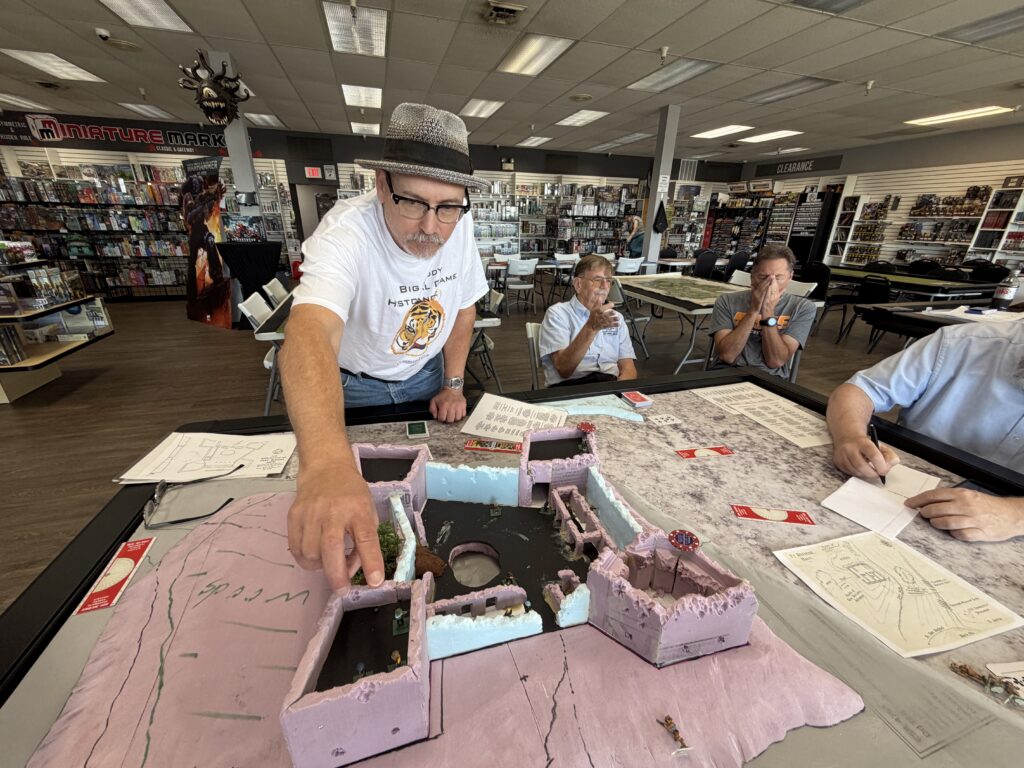
“We did some testing of individual changes to see if it had the right feel and it was clear things were moving on a positive direction for development of the scenario, but that more playtesting and development is needed. Kevin mentioned that this scenario would be on the schedule to be played again fairlly soon. l!”
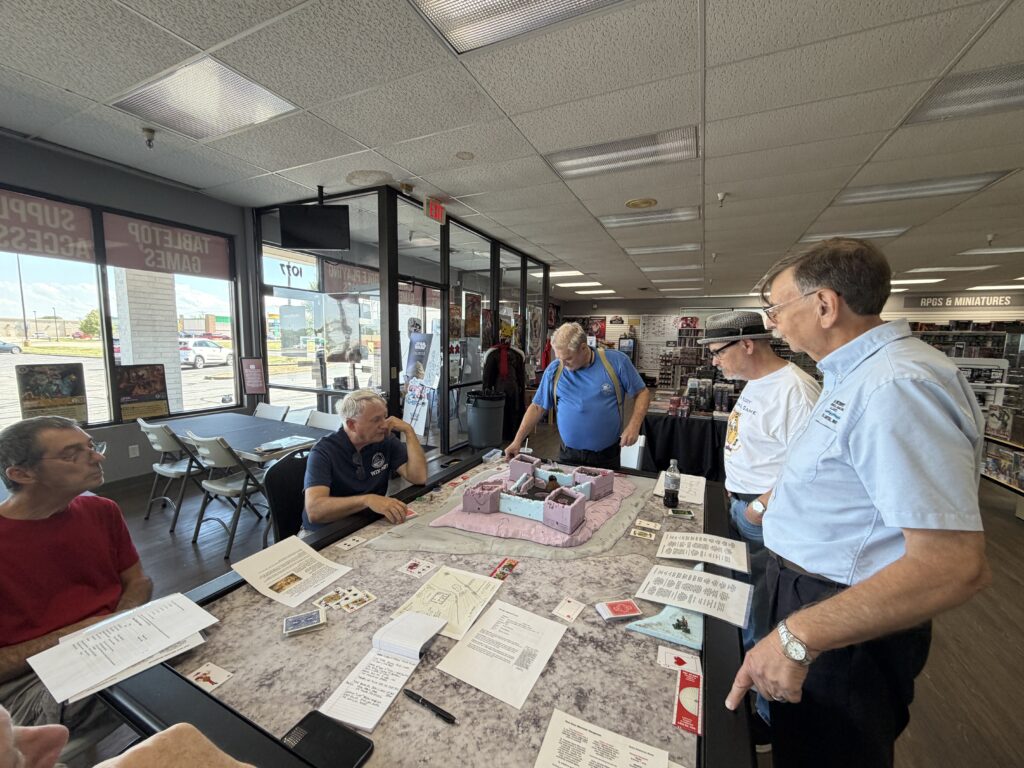
Thanks to Jay for his great report and to all the players who came out to help with the game play and their many valuable suggestions.. Great to see Greg D stop by, We would also like to add our ongoing appreciation to Miniature Market Cave Springs for their continued support.
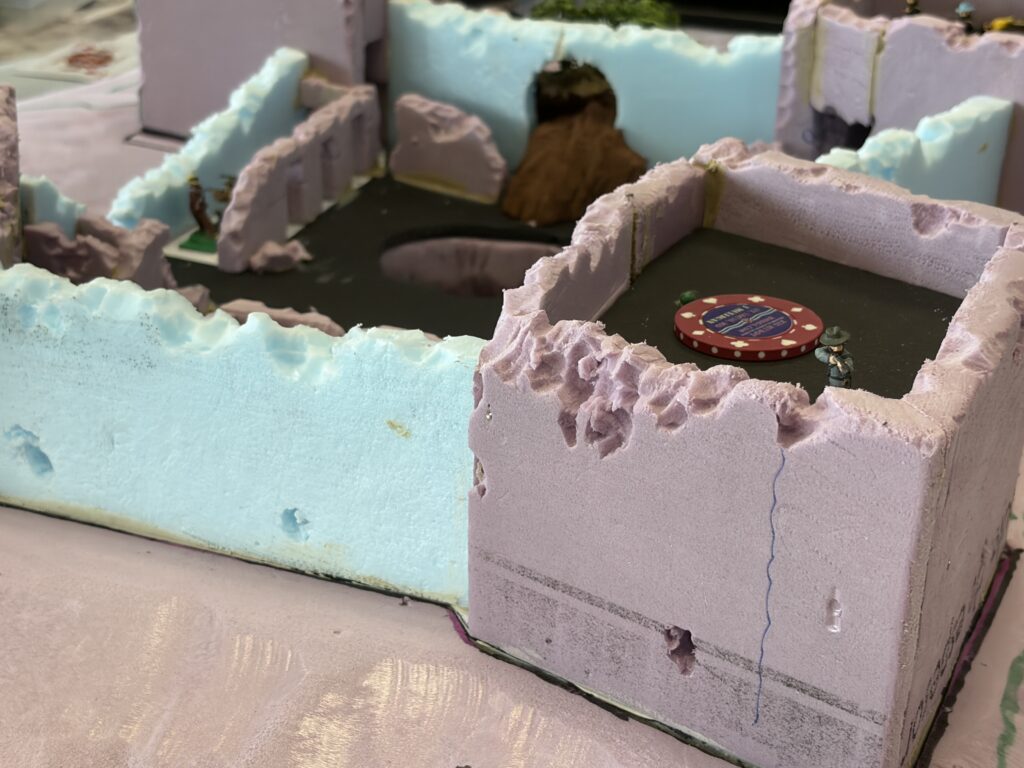
The poker chip represents the area being targeted by machine gun fire.
Remember to shop local!
Big Muddy Historical Game Alliance of Greater St. Louis
Our public educational demonstrations including rules and game evaluation sessions use historical miniature and historical board gaming to explore military history, historical decision-making, and the people, places, and events of the past.
Historical Gaming in Action is a public educational program presented by the Big Muddy Historical Game Alliance of Greater St. Louis.
Using miniature figures, terrain, maps, historical research, and guided play, our games explore military history through the decisions faced by commanders, soldiers, and communities. Visitors can examine the table, ask questions, learn about the historical setting, and—when space and time permit—join the game.
Our scenarios are based on historical sources. While game rules simplify some details for practical play, each event is designed to encourage discussion of historical events, geography, leadership, logistics, strategy, and the human experience of conflict.
Historical gaming can be both enjoyable and educational. Big Muddy provides public educational demonstrations, seminars, and convention programming that promote historical miniature gaming and military history.